
Ten Thousandths of a Coin: The Waiting Time Behind 0.01 BTC
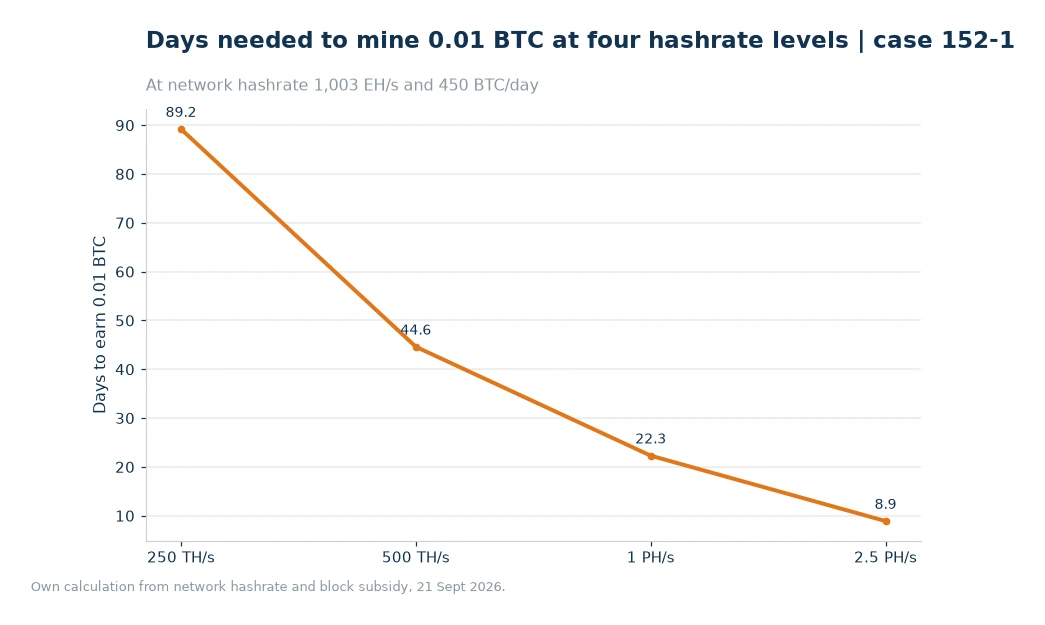
A solo miner waits for one block. A pool miner waits for an amount. Those are different calendars, and mixing them up is how people buy a machine expecting a payout that belongs to a different strategy. At 250 TH/s, 0.01 BTC arrives in 89.2 days; at 2.5 PH/s the same amount takes 8.9 days, and neither figure involves a block being found by your hardware.
Key takeaways
- 0.01 BTC is 89.2 days of work at 250 TH/s and 8.9 days at 2.5 PH/s under the 21 September 2026 reading.
- A pool miner's wait is arithmetic; a solo miner's wait is a probability with a very long tail.
- PPS+ removes pool luck from your credit, while PPLNS puts it back into the timing of payments.
- Shorten the calendar with hashrate or patience, not with a different dashboard.
Two calendars that share a units problem
When someone says a machine "earns 0.00011215 BTC a day", they have already divided a block reward into slices small enough to be paid hourly. The slice is real, and it arrives whether or not the pool found a block that hour, because the pool settles the block-reward component against current difficulty. What the miner gives up for that regularity is a listed 4% on that component.
Solo mining keeps the whole reward and removes the fee, but it also removes the schedule. A 250 TH/s machine against a 1,003 EH/s network holds a share of about 2.49e-07, so the expected wait for one block is roughly four million blocks, which is not a plan anyone can budget around. The pool exists to turn that lottery ticket into a wage, and the wage is what the 89.2-day figure describes.
Variance without the formulas
Pool Luck is the pool's found blocks measured against what its share of the network should produce. A run of bad luck means fewer blocks than expected in a window; a run of good luck means more. If you are paid through PPLNS, that swing reaches your statement because payments wait for six confirmations and then spread the block's value across the last five difficulty rounds. If you are paid through PPS+, it does not.
The pool's own slice of the network matters here. A larger Pool Hashrate means more blocks per day, which makes the pool's luck smoother and the payment rhythm more even for PPLNS miners. A small pool can have a quiet week and a busy week with the same underlying hashrate. Neither outcome changes what a PPS+ miner receives, which is the whole argument for the default scheme when the power bill arrives on a fixed date.
Where to look at the numbers: the ViaBTC BTC Mining Pool state view shows the pool's hashrate and its recent luck side by side, which is enough to see whether a run of thin payments is the pool's doing or the network's. Check it once a week rather than once an hour, because the window the page reports is wider than a single shift and a single shift proves nothing.
The waiting ladder at four hashrates
Holding the target at 0.01 BTC and moving only the hashrate gives the table below. Every row uses the same network reading, so the differences come entirely from the machines.
| Hashrate | BTC per day | Days to 0.01 BTC | Calendar in months |
|---|---|---|---|
| 250 TH/s | 0.00011215 | 89.2 | 2.9 |
| 500 TH/s | 0.00022430 | 44.6 | 1.5 |
| 1 PH/s | 0.00044861 | 22.3 | 0.7 |
| 2.5 PH/s | 0.00112152 | 8.9 | 0.3 |
Notice that the months column never reaches a year at the top end, and never drops below a quarter at the bottom. That is the honest range for a single-pool, single-target plan. If your target is a year away, you are not really buying hashrate; you are buying an option on the network slowing down or the price rising, and those are separate bets.
Worked example
Build the 250 TH/s row from the chain inputs, then test what a difficulty change does to the date.
- A terahash yields 450 ÷ 1,003,000,000 = 0.00000044865 BTC a day.
- 250 TH/s: 250 × 0.00000044865 = 0.00011216 BTC a day, rounded to 0.00011215.
- Days to target: 0.01 ÷ 0.00011215 = 89.16, so 89.2 days.
- Value of the target at $84,692: 0.01 × 84,692 = $846.92.
- If the estimate of a 2.12% difficulty cut holds, output rises by about 2.17%: 0.00011215 × 1.0217 = 0.00011458 BTC a day.
- The new wait is 0.01 ÷ 0.00011458 = 87.3 days, about two days shorter.
- Two days is 2.2% of the calendar; a machine that runs 98% of the time instead of 100% gives back roughly the same amount, which is why uptime deserves equal attention.
A solo miner's luck is not the pool's luck
The word luck appears in both conversations and means different things. For a pool, it is a bookkeeping comparison between blocks found and blocks expected. For a solo miner, it is the entire outcome: either a block arrives or it does not, and the distribution has a long tail in both directions. A solo miner can wait years and then find two blocks in a month, which is not luck in any sense a budget can use.
This is why the pool's fee is better understood as the price of a schedule rather than a deduction from winnings. The 4% on the block-reward component buys hourly settlement at current difficulty; the 2% on the transaction-fee component is a different charge on a different stream. A solo miner pays neither and receives nothing most days. Whether that trade is worth it depends on whether you need the coins this month.
When the difficulty forecast moves the date
The next adjustment was estimated at −2.12% when the inputs were read. A cut in difficulty raises everyone's output slightly, and the arithmetic above turns it into two days off an 89-day wait. A rise of the same size adds about two days. Neither is a reason to change a plan, but both belong in the note you keep beside the target, because a run of small adjustments in the same direction compounds into a month over a year.
Price moves faster than difficulty and matters more to a dollar target. The coin target is deliberately immune to that, which is why it is the better planning unit for someone accumulating rather than selling. Watch the price for the decision to sell; watch difficulty for the decision to wait. The Profit Calculator will re-run the day count whenever either input changes.
Frequently asked questions
How long does 0.01 BTC take at 500 TH/s?
About 44.6 days at the 21 September 2026 network reading, since 500 TH/s produces 0.0002243 BTC a day and 0.01 divided by that daily figure is 44.6.
Can a solo miner reach 0.01 BTC faster than a pool miner?
Only by finding a block early, which is a low-probability event with a long tail; a pool miner at the same hashrate reaches 0.01 BTC on a predictable schedule because PPS+ settles hourly against current difficulty.
Does a bigger pool make my 0.01 BTC arrive sooner?
No. Your daily output depends on your hashrate against the whole network, so a larger Pool Hashrate changes how smoothly the pool finds blocks, not the size of your slice.
Choose the wait before you choose the machine
Decide how many days you are willing to run before the first meaningful withdrawal, then work backwards to a hashrate. Two hundred and fifty TH/s buys about three months; two and a half petahash buys about nine days. The machine is the easy part to change later. The target and the patience are the parts that set everything else, and the pricing page is where the fee side of that decision becomes concrete.
Sources: ViaBTC pool state and fee pages, for the hashrate denominator and the 4%/2% split between streams[1]. Readings from 21 Sept 2026: 1,003 EH/s, difficulty 132.76 T, 3.125 BTC subsidy, 144 blocks a day, $84,692 per BTC, next adjustment estimated −2.12%. Source figures read 21 Sept 2026, published 24 Oct 2026. Waits assume continuous hashing.