
Sensory Storytelling for Body Care: What Scent Museums Changed
Scent museums spent the last decade solving a problem that body care retailers share: how to present a smell to somebody who cannot see it. The solutions they developed, from controlled sequencing to stations built around a single material, have been moving into shops and brand spaces ever since. The transfer is not automatic, because a museum can ask a visitor to spend an hour and a shelf cannot. What has changed is that the techniques are now practical at retail scale, and brands that ignore them are competing with a weaker presentation than their product deserves.
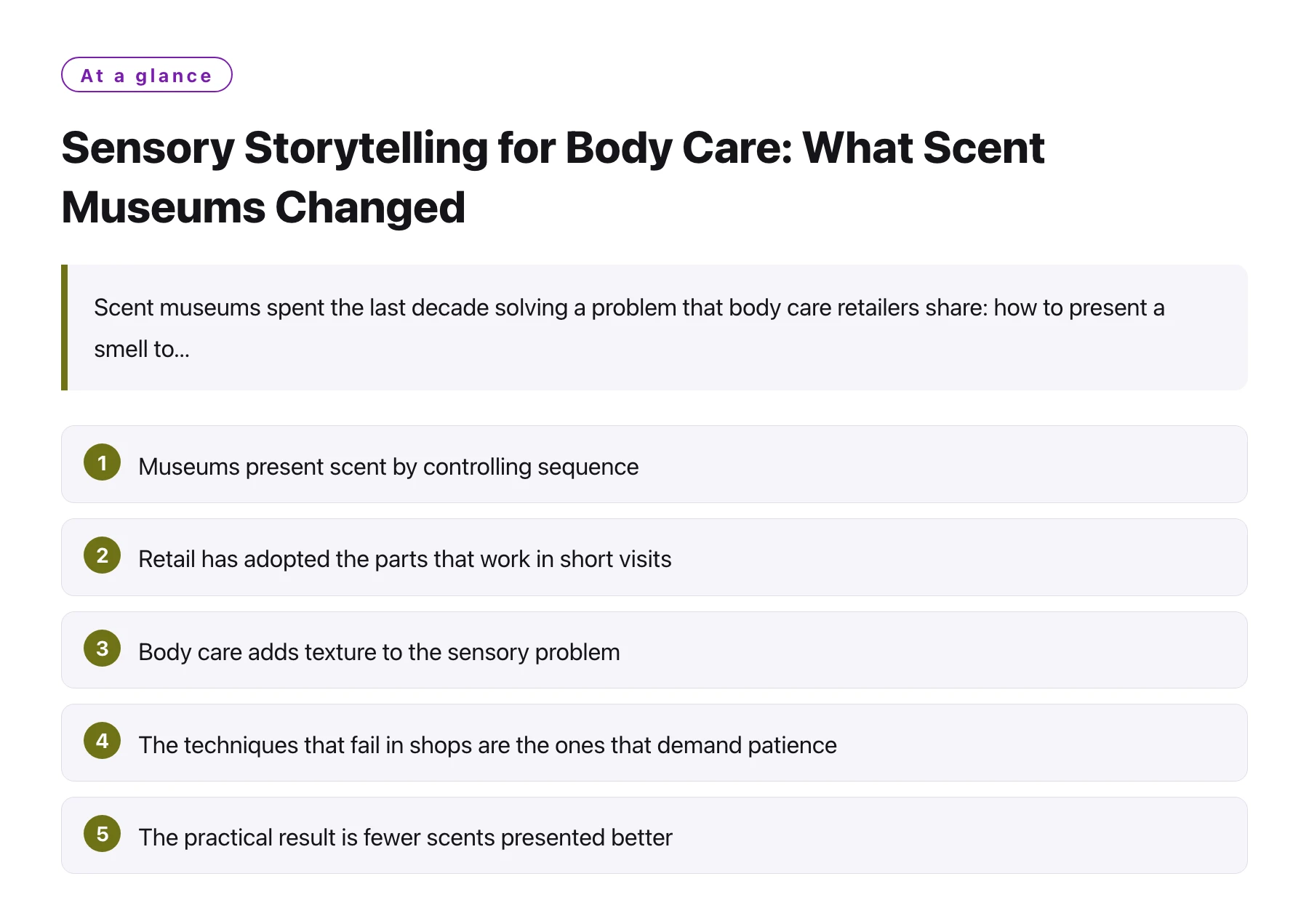
Key takeaways
- Museums present scent by controlling sequence, contrast and time, which is a different discipline from placing bottles on a shelf.
- Retail has adopted the parts that work in short visits, such as single-material stations and guided comparison rather than a wall of unlabelled testers.
- Body care adds texture to the sensory problem, because the product is touched as well as smelled, and the two impressions have to agree.
- The techniques that fail in shops are the ones that demand patience, silence or a guided host that a retail floor cannot staff.
- The practical result is fewer scents presented better, rather than a wider range presented without structure.
Walk into a scent museum and the sequence is designed. A visitor meets one material at a time, in a controlled order, with enough contrast between stations for the nose to register a difference. There is nothing accidental about which smell comes first.
A body care shelf usually does the opposite. Dozens of products, similar packaging, testers that have been open for months and no order at all. The gap between those two experiences is the subject of this article, written for brand and retail teams planning how a range is presented rather than how it is made.
What changed in the last few years
Three shifts made museum practice relevant to ordinary retail. First, scent marketing moved from a novelty into a standard part of brand presentation, which produced suppliers, vocabulary and a body of practical experience. Second, brands began treating a signature scent as an asset to be staged rather than a line on a label. Third, retail formats changed: concept stores, pop-ups and brand counters now exist precisely to host an experience, which gives a sensory sequence somewhere to live.
The result is that the question is no longer whether a brand should design a scent experience, but how much of one fits the space and the visit length. Museums are the reference library for those answers, and their own professional bodies describe the field as one that combines collection care with public interpretation [1].
Sensory storytelling also works best when it connects to something real. A brand that can describe where its scent came from has material for a station, a card or a short film, and the company behind the factory is often the least used story asset available to a small brand.
Museum techniques that moved into the shop
| Museum technique | What it solves | How it appears on a body care shelf |
|---|---|---|
| One material at a time | The nose cannot separate five scents presented together | Single-note stations, or a range presented in a deliberate order |
| Controlled sequence | First impressions anchor everything that follows | The lightest format opens, the richest closes |
| Contrast between stations | Similar scents blur into one another | A neutral element such as coffee beans or unscented lotion between stops |
| Text and object pairing | A smell alone has no vocabulary | A short written line next to the tester, naming one or two materials |
| Time built into the route | Dry-down is lost when visitors rush | A sample to take away and apply later, rather than a decision at the shelf |
The last row is the most useful transfer, because it accepts a limitation instead of fighting it: a shop cannot hold a customer for an hour, so the experience continues at home.
What a body care brand should copy, and what it should not
Copy the structure, not the theatre. A museum can afford silence, dim light and a host who guides one visitor at a time; a shop cannot, and an attempt to reproduce that atmosphere usually produces a space that feels awkward and slows the queue. The parts worth taking are the ones that work without staff attention: ordering, contrast, clear labelling and a sample that leaves with the customer.
Keep the texture in view as well. A body care product is judged with the hands as much as with the nose, and a tester that has separated or dried out undermines the scent it is meant to present. The two impressions have to agree, which is a merchandising discipline as much as a formulation one.
Capability makes better storytelling
Teams that understand materials describe them more accurately, which shows up in better labels, better training for retail staff and fewer claims that cannot be supported. That is one practical reason fragrance education has moved from the perfumer's studio into brand teams, and why a place to learn perfumery is now a relevant search for marketing and product people rather than only for chemists.
Applying this to a body care range
Start with the range you have rather than the space you wish you had. Group the products into two or three scent families, decide the order in which a customer should meet them, and write one short line for each that names a material rather than an adjective. That work costs almost nothing and it changes how the shelf reads.
Then decide what leaves with the customer. A small sample of the format that best carries the scent is worth more than a discount, because it moves the decision to a moment when the customer is not standing in a queue. Finally, train whoever is on the floor on the same three sentences you put on the cards, so the spoken version and the printed version agree.
None of this requires a flagship space. It requires the same discipline a museum applies to a collection: decide what the visitor meets first, what they meet next, and what they take away.
It also helps to borrow a story that already exists. A manufacturing partner with a scent collection of its own, such as the one operated by fragrance museum in Guangzhou, can give a small brand access to a staged version of the narrative it is trying to tell, which is difficult to build from scratch on a launch budget.
The common failure is presenting everything at once. If a visitor can only remember two or three scents from a visit, the shelf should be built around two or three scents, with the rest of the range available without competing for attention.
Sources
- ICOM — International Council of Museums —— The international organisation representing museums; publishes the ICOM museum definition and professional standards for museum practice.
Frequently asked questions
Is a sensory scent experience worth it for a small body care brand?
A modest version is. Ordering the range, labelling testers with one or two named materials and offering a take-away sample costs little and changes how the range is understood. Large installations can wait until the range and the market are proven.
Why do coffee beans between testers not really work?
Coffee is a strong smell rather than a neutral one, so it replaces the previous scent with another scent instead of clearing the nose. Fresh air, a short pause, or a genuinely neutral material such as unscented lotion is a better reset.
How many scents should a tester display show?
Fewer than most brands attempt. Two or three presented properly will be remembered; eight presented at once will not, which is exactly the lesson museum sequencing teaches.
Should the tester match the scent or the format?
Both, ideally. A customer smelling a lotion tester is judging the texture and the scent together, so a tester that has separated or dried out contradicts the story the card is telling.
Does fragrance training help a marketing team?
It usually improves the accuracy of what the team writes and says about a scent. Naming materials correctly and describing dry-down honestly supports claims that can be defended, which matters in a category where scent words are easy to overstate.
FPS Briefing · WeeklyGet every benchmark, build guide and mouse test in your inbox before it hits the front page.
Join the FPS Briefing